What Is a Jet Boat? How the New Zealand Invention Works
A jet boat has no propeller: it pumps water out of a steerable nozzle. How the New Zealand invention works, why it runs in 10 cm of water, the Hamilton spin, safety rules and where to ride one in Queenstown.
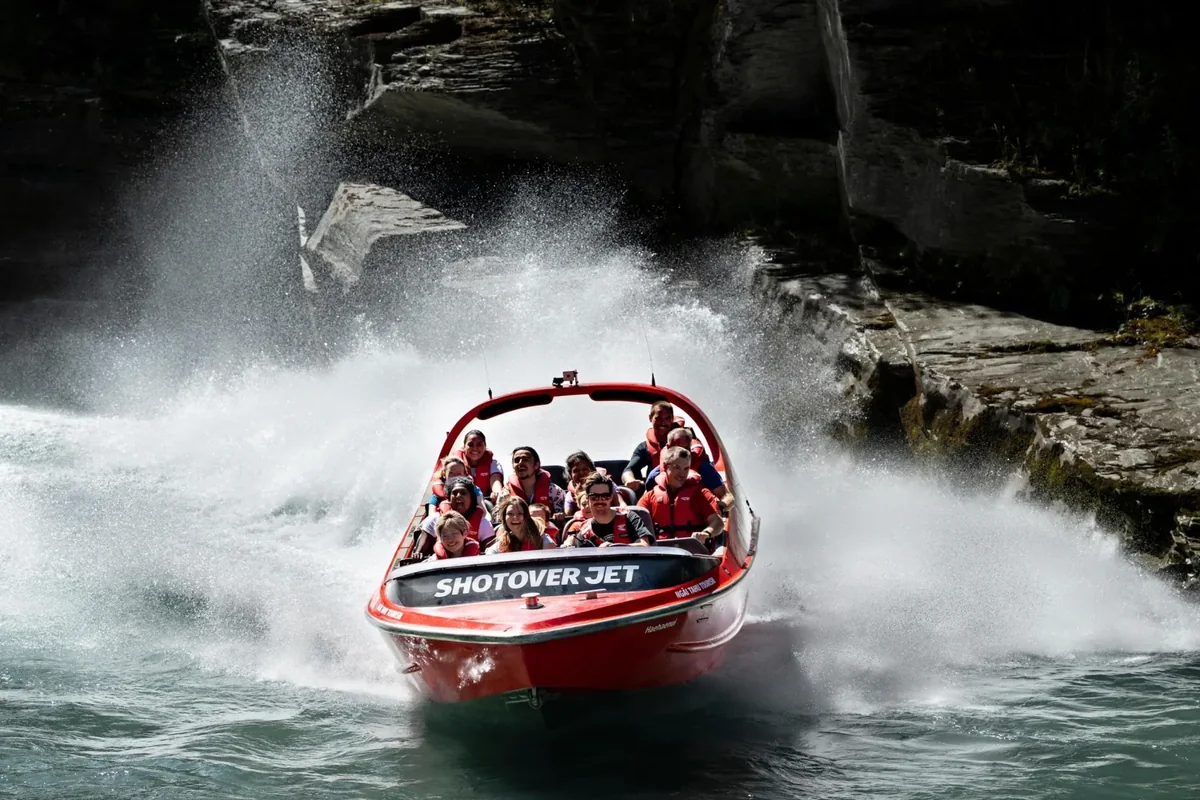
A jet boat is a boat with no propeller. An engine-driven pump sucks water in through a grille in the hull and fires it out of a steerable nozzle at the stern, which pushes the boat forward and lets it skim through water that would wreck a propeller. A South Canterbury sheep farmer called Bill Hamilton made the first practical version in the 1950s, and Queenstown operators still use his company’s jet units to run canyon rivers as shallow as 10 cm. The best way to understand one is to ride the Shotover Jet: twin Hamilton jets, narrow canyon walls and the 360° “Hamilton spin.”
Check Availability
Key findings
| Question | Short answer | Source |
|---|---|---|
| What is a jet boat? | A boat pushed along by a pump-driven water jet instead of a propeller | KJet; Shotover Jet; Discover Boating |
| Who invented it? | Bill Hamilton, Irishman Creek Station, NZ: first jet unit 1954 | HamiltonJet; Te Ara |
| How shallow can it go? | Queenstown operators say about 10 cm when planing; KJet says “less than 5cm”; HamiltonJet says the HJ212 can do it in “as little as 50mm” | Shotover Jet; Dart River; KJet; HamiltonJet |
| How fast? | Queenstown and Glenorchy tourist boats go up to 85–95 km/h; Huka Falls Jet up to 80 km/h | Operator sites |
| First commercial jet boat ride? | KJet (Kawarau Jet), Queenstown, 1958 (the operator’s own claim) | KJet |
| Are they regulated? | Yes. In NZ, commercial river jet boats fall under Maritime Rules Part 82, signed into law on 3 July 2012. It covers river boats “less than nine metres in length” carrying “no more that 34 people”, and drivers must hold a commercial licence | Maritime NZ |
| Are they safe? | Most rides go without incident: the Shotover Jet alone has carried “more than 4.6 million passengers since its first commercial ride in 1965.” Canyon jet boating still carries real risk, and accidents do happen | Australasian Leisure Management / NZ Herald; TAIC; Ministry of Transport |
In 30 seconds. A jet boat is driven by a waterjet: an internal pump takes in water through an intake in the hull bottom and pushes it out through a steerable nozzle at the stern. The reaction to that jet (Newton’s third law) moves the boat. There is no external propeller or rudder, so a planing jet boat needs very little water. You steer by aiming the nozzle, and you stop or reverse by lowering a deflector (the “reverse bucket”) into the jet. The modern jet boat was developed in New Zealand by C.W.F. (Bill) Hamilton in the 1950s. His company, HamiltonJet, now supplies waterjets to ferries, patrol boats and rescue craft around the world.
How does a jet boat work?
An engine spins an impeller inside a tube in the hull. The impeller pressurises water drawn in from under the boat, and a nozzle at the stern turns that pressure into a fast rearward jet that pushes the boat forward. In KJet’s words, water is “‘sucked in’ to the Jet unit and forced out, propelling the boat forward.”
The five main parts
| Part | What it does | Plain-English comparison |
|---|---|---|
| Intake (with grille) | A flush opening in the hull bottom. Water enters here and the grille keeps big stones out | The straw |
| Impeller | A shrouded internal “propeller” driven by the engine shaft that pressurises the water | The pump in a garden hose system |
| Stator vanes | Fixed vanes behind the impeller that straighten the swirling flow so more energy becomes thrust | Straightening a wobbly hose stream |
| Steering nozzle | Swivels left and right to aim the jet. Pointing it one way pushes the stern the other way | Your thumb over the hose end |
| Reverse bucket (astern deflector) | Drops over the jet and turns it forward and down to slow, stop or reverse the boat | Cupping your hand over the hose to spray back at yourself |
KJet explains the stopping trick this way: “To make the boats reverse or stand still, an astern deflector is lowered into the Jet stream after the water leaves the nozzle.” Steering works because “Pointing the Jet stream one way forces the stern of the boat in the opposite direction which puts the boat into a turn.”
Diagram: how a waterjet works
Newton’s third law in one sentence
Fire a mass of water backwards fast enough and the boat goes forwards. That is all the physics there is. Bill Hamilton joked that the credit “belongs to a gentleman named Archimedes, who lived some years ago.”
The engineering changes that made it work
Te Ara points out that Hamilton “never claimed to have invented the jet-boat; the water-jet principle was not new and had already been applied with some success to low-speed displacement craft overseas.” His team’s contribution was “designing a jet unit that would propel a planing hull efficiently at high speeds and with the advantages of a shallow draught.” Two changes mattered most:
- Moving the jet outlet above the waterline. His first boat fired its jet below the waterline. Expelling it above, into air, “significantly increased efficiency of the unit, and therefore thrust and speed,” according to a history of the licensed British Dowty jet boats.
- Switching from a centrifugal pump to a multi-stage axial-flow pump. Water then runs straight through the unit in line with the boat. HamiltonJet describes this as the change that “allowed boats to travel to places that had never been accessible before.”
Where jets fall short
- Low-speed steering is poor. No thrust means no steering. Discover Boating notes a jet “may not track as well at no-wake speeds and can be trickier to handle around a dock.”
- They burn more fuel at low and moderate speeds. US Patent 6,193,571 (“Enhanced waterjet propulsor”) states that “the waterjet propulsor is severely outclassed from efficiency standpoints at low to moderate, up to about 25 knot, and very high, over 60 knot, speeds.” Jets come into their own at high speed.
- Debris. Stones, weed and silt can wear or jam the impeller. TAIC’s report on the Shotover Jet’s 1999 accidents found that fine debris could lodge “between the steering nozzle and its casing” on the HJ212 units of that time.
- No trim. Discover Boating notes that, unlike a sterndrive, “the jet nozzle is not trimmable.”
Why can a jet boat run in 10 cm of water?
Nothing hangs below the hull (no propeller, rudder or gearbox), and once the boat is planing at speed the hull rides on top of the water instead of sitting in it. Shotover Jet says its boats “are easy to maneuver in water as shallow as 10cm.” Dart River Adventures says jet boats can navigate “very shallow tracts of water, as low as 10cm in depth!”
Three things make this possible:
- A flush bottom. KJet: “The Jet unit is streamline and does not sit below the bottom of the boat, meaning it can travel across much shallower water.”
- Planing. At speed a planing hull lifts and skims, so the boat’s effective draft shrinks a lot. The 10 cm figures hold only while the boat is moving fast. At rest or idling, a heavy commercial boat sits deeper.
- The intake only needs water touching the hull. The pump draws from directly under the boat, so a thin layer of water over gravel is enough while planing.
How shallow? The claims compared
| Source | Claim | Context |
|---|---|---|
| Shotover Jet | “as shallow as 10cm” | Commercial canyon boats, twin HJ212 |
| Dart River Adventures | “as low as 10cm in depth” | Wilderness river, Glenorchy |
| KJet | “speeds of up to 95kph in water that’s less than 5cm deep” | Operator marketing claim |
| HamiltonJet (via Offshore Energy) | HJ212 can push a boat “at over 100kph in as little as 50mm deep water” | Manufacturer claim, light recreational and race boats |
| NZ Maritime Museum | Hamilton’s early boats could “plane upstream in water less than 10 cm deep” | Historical account |
10 cm is the repeatable number for a fully loaded commercial boat. The 5 cm figures are real but apply to lighter boats in ideal conditions, so don’t expect them on your ride.
What is the Hamilton spin?
The Hamilton spin (or Hamilton turn) is a high-speed 360° turn: the driver cuts the throttle, swings the wheel hard and powers back on, so the stern slides round and the boat pivots almost on its own length in a sheet of spray. Bill Hamilton used it to show off to buyers. The NZ Maritime Museum says he “would steer straight ahead at break-neck speed, and then execute a 360-degree turn; the lose-your-lunch manoeuvre became known as ’the Hamilton spin’.”
- Why only jets can do it: steering comes from aiming thrust, and no drive leg digs into the water like a keel, so the stern can be shoved sideways hard.
- On your ride: NZ commercial operators must tell passengers in the safety briefing that “spins, extreme turns, and other manoeuvres will be undertaken” (Maritime NZ). The driver usually signals with a hand twirl first. That is your cue to grip the handrail.
- Wet factor: the spin throws most of the spray. Outer seats get splashed and centre seats stay drier; our guide to getting wet on the Shotover Jet has the detail.
Jet boat vs propeller boat vs jet ski vs airboat vs hovercraft
A jet boat is a full boat with an internal waterjet. A jet ski (PWC) is a sit-on waterjet craft. A propeller boat uses an external prop. An airboat is pushed by an air propeller, and a hovercraft rides on a cushion of air. Only the last two can cross dry ground. The jet boat is the one built for speed in shallow, rocky rivers.
| Craft | Propulsion | Shallow water | Low-speed control | Typical use | Notes |
|---|---|---|---|---|---|
| Jet boat | Internal waterjet pump | Excellent (about 10 cm when planing) | Fair to poor | River tours, rescue, ferries, patrol | Hull bottom is flush. Loud V8s on tourist boats |
| Propeller boat (outboard / sterndrive) | External propeller and rudder or steerable drive | Poor (prop and leg hang below the hull) | Good | Lakes, coastal, fishing, skiing | Generally more fuel-efficient at cruise. Prop strikes are a hazard |
| Jet ski / PWC | Small internal waterjet (same principle) | Good | Fair | Recreation | Rider sits astride. A small jet boat in principle, not a “speed boat” |
| Airboat | Aircraft-style propeller in the air | Excellent (water, mud, weeds) | Poor | Swamps, Everglades tours | Very loud. No underwater parts |
| Hovercraft | Fans and an air cushion | Crosses land, ice, mud | Poor | Rescue, ferries, novelty | Doesn’t touch the water. Drifts in wind |
Jet boat vs propeller boat in one line: propellers are more efficient and easier to dock, while jets are safer around people in the water, tougher in shallows and far more agile at speed. Discover Boating sums up the jet’s draft advantage: “Because the entire jet drive system is located within the hull, a jet boat has minimal draft and can operate in very shallow water.”
Is a jet boat a “speed boat”? In everyday speech, yes: any fast powerboat gets called a speed boat. Strictly, “jet boat” describes the propulsion, and a slow ferry can be waterjet-driven too.
Who invented the jet boat? The Bill Hamilton story
The modern jet boat was developed by New Zealander Charles William Feilden “Bill” Hamilton (1899–1978) and his team at Irishman Creek Station, a high-country sheep run between Lakes Tekapo and Pukaki, with the first working jet unit built in 1954. Hamilton wanted a boat that could go up the shallow, braided, shingle-bed rivers near his farm, the kind the NZ Maritime Museum called “brutal on propellers.”
The story in five parts:
- A boy who wanted to go upstream. NZ Geographic tells how young Bill at Ashwick Station built a bamboo-and-canvas canoe, then rigged a trailer pulled by “a reluctant brown retriever” to haul it back up after each downstream run. “What he really needed was a boat that could go upstream.”
- The farm became a factory. Hamilton bought Irishman Creek in 1921 and built a workshop and a hydro scheme. He invented earth-moving scoops, made munitions parts in the Second World War, and set up C.W.F. Hamilton & Co in 1939.
- Retractable propellers failed. He went back to the river-boat idea in 1951. Propeller designs didn’t work, so in 1954 he built a jet unit “using a centrifugal pump driven by a bevel gear” (HamiltonJet). His first jet boat, Whio, was a plywood boat of roughly four metres with a 100E Ford engine (NZ Geographic; another account gives 3.6 m).
- A small team made it work. Engineer George Davison and Bill’s son Jon were central. The NZ Maritime Museum describes the 1956 “Chinook” unit as the model “which made the jet boat commercially viable.”
- Recognition. OBE in 1961 “especially in the design and construction of the jet-propelled motorboat.” Knighted in 1974 “for services to manufacturing.” Inducted into the NZ Sports Hall of Fame (1990) and the NZ Business Hall of Fame (2004). NZ Post featured the Hamilton jet boat on stamps issued in 1999 and 2007.
“I do not claim to have invented marine jet propulsion. The honour belongs to a gentleman named Archimedes, who lived some years ago.” (Bill Hamilton)
So who invented the jet boat? Water-jet propulsion had been tried before, including the American Hanley Hydro-Jet that Hamilton studied, but Bill Hamilton’s team built the first practical high-speed jet boat. Every Queenstown jet boat descends from it.
Timeline: from farm shed to the Grand Canyon and the Ganges
| Year | Milestone | Source |
|---|---|---|
| 1899 | Bill Hamilton born at Ashwick Station, near Fairlie, South Canterbury | Te Ara |
| 1921 | Buys Irishman Creek Station, Mackenzie Country | HamiltonJet; NZ Geographic |
| 1939 | C.W.F. Hamilton & Co Ltd formed at the Irishman Creek workshop | HamiltonJet |
| 1951 | Revives the shallow-river boat idea; retractable propeller fails | HamiltonJet; KJet |
| 1954 | First jet unit (centrifugal pump, bevel gear, Ford engine) | HamiltonJet; Te Ara |
| 1956 | First batch of “Rainbow” jet units; “Chinook” prototype | HamiltonJet; NZ Maritime Museum |
| 1950s | Bill and Peggy run the 234 km Whanganui River in nine hours, “four times faster than any other boat before” | NZ Geographic |
| 1958 | Melhop brothers make the first jet-powered run of the Kawarau Falls dam; KJet traces its start to this | KJet |
| 1959 | Bill and Peggy make an upstream run of a 160 km stretch of the Colorado | HamiltonJet |
| 1960 | Jon Hamilton leads jet boats up the Grand Canyon, climbing Lava Falls (Vulcan Rapid). They reach Lees Ferry on 12 July 1960 with three of four boats | HamiltonJet; NAU Colorado Plateau Archives |
| 1961 | Bill Hamilton appointed OBE | HamiltonJet; Te Ara |
| 1963 | “Colorado” series jets halve the cost of a unit | HamiltonJet |
| 1965 | Shotover Jet starts on the Shotover River at Arthurs Point | Shotover Jet |
| 1974 | Hamilton knighted | Te Ara |
| 1977 | Sir Edmund Hillary’s “Ocean to Sky” expedition takes three Hamilton jet boats up the Ganges from the Bay of Bengal into the Himalaya | NZ History; NZ Geographic |
| 1978 | Sir William Hamilton dies | Te Ara |
| Early 1980s | Jet sprinting invented in New Zealand | Te Ara |
| 1988 | First jet sprint world championships | Te Ara |
| 1990 | Huka Falls Jet opens on the Waikato River, Taupō | Hukafalls Jet |
| 1995 | First HJ212, HamiltonJet’s smallest model and the tourist-boat workhorse | Offshore Energy |
| 2022 | Shotover Jet unveils an electric jet boat prototype | Ngāi Tahu; ODT |
| 2025 | Shotover Jet turns 60, with more than 4.6 million passengers | Ngāi Tahu |
The Grand Canyon run. A caption in Northern Arizona University’s Colorado Plateau Archives calls it the “only expedition ever to drive boats up Grand Canyon from Lake Mead to Lee’s Ferry.” John Wesley Powell, who made the first descent in 1869, had written: “No man could take a boat into those rapids and survive” (quoted by NZ Geographic). One of the four boats sank in Grapevine Rapid. Other expedition rivers listed by HamiltonJet include the Sun Kosi (Nepal), Sepik (PNG), Zaire and Amazon.
How New Zealand turned jet boats into tourism
Commercial jet boat rides began in Queenstown. KJet (Kawarau Jet) traces its origin to 1958 and calls itself “the world’s first commercial Jet boat operator,” and the Shotover Jet began carrying passengers in 1965.
- KJet (1958 onwards). Invercargill engineers Alan and Harold Melhop held the Hamilton Jet agency and were trustees of a Christian youth camp. KJet says they “made the first jet-powered navigation of the Kawarau Falls dam” in 1958. Destination Queenstown adds that in 1959 “they started jet boat joy rides for five shillings a spin.” Some sources date the business to 1958 and others to 1959; we use 1958 for the first run and 1959 for paid rides. Today the KJet ride runs an hour on Lake Wakatipu and two rivers, from US$84, 4.7 from 2,022 reviews.
- Shotover Jet (1965 onwards). It started with a “Jet 30” fibreglass boat that carried five passengers, and took 1,480 passengers in its first year (Shotover Jet). Ngāi Tahu, the South Island iwi, became majority owner in 1999 and full owner by 2004. It is now the only operator permitted in the Shotover canyons, a concession dating to the 1987 Shotover River Empowering Act (Te Karaka).
- The industry today. In 2012, the latest official count we found, the Ministry of Transport counted “94 commercial jet boats used by 47 commercial jet boat operators” carrying an estimated “370,000 passengers annually,” more than 200,000 of them international visitors.
The Shotover Jet’s founding is told slightly differently in different places. Ngāi Tahu’s Te Karaka timeline says the Melhops launched “Shotover Jet Services” in 1965 and sold to employee Herm Palmer. The ODT calls Palmer the first driver. Both versions agree on 1965.
For Queenstown’s operators side by side, see which Queenstown jet boat to book and Dart River Jet vs Shotover Jet.
Inside a commercial jet boat: the Shotover Jet
A Shotover Jet boat is a purpose-built aluminium hull driven by two 350 MerCruiser V8s (700 hp combined) feeding two Hamilton HJ212 jet units that move 760 litres of water per second. The published spec:
| Spec | Shotover Jet | Source |
|---|---|---|
| Fleet | 7 “interchangeable highly specialised jet boats” | Shotover Jet |
| Hull | Heavy-gauge marine aluminium, built in Queenstown | Shotover Jet; Hukafalls Jet |
| Engines | Two 350 MerCruiser V8s, 700 hp combined | Shotover Jet |
| Jet units | Two Hamilton 212 (HJ212) | Shotover Jet |
| Water flow | 760 litres per second | Shotover Jet |
| Top speed | “up to 90kph” | Shotover Jet |
| Minimum water | “as shallow as 10cm” | Shotover Jet |
| Capacity | 14 people per boat (reported) | Plugboats |
| Comfort | Heated handrails | Operator FAQ / resellers |
| Driver training | Minimum 120 hours, “more than double the 50 hours required” | Shotover Jet |
About the HJ212: it is HamiltonJet’s smallest waterjet (215 mm), “most commonly used to propel recreational craft from six to nine meters long and commercial ’thrill-ride’ tourist vessels carrying up to 20 people” (Offshore Energy). The 10,000th unit went into a Canadian boat. NauticExpo’s HamiltonJet HJ212 listing gives “Power: 260 kW (354 hp),” a maximum of 3,950–4,500 rpm and a “Dry weight: 75 kg (165 lb).”
For comparison: Huka Falls Jet runs twin HJ212s “thrusting 800 litres of water per second” with “up to a combined total of 700hp.” KJet says its units “pump at 4000 R.P.M.” and that its two-seat race boat, with a T58 gas-turbine engine, can top 200 km/h.
Are jet boats safe? Rules, training and the record
Commercial jet boating in New Zealand is tightly regulated and the large majority of rides go without incident, but it is a high-risk activity, and serious accidents, including deaths, have happened. Pick a certified operator, listen to the briefing and hold on. Every notable crash since 1999 is in our full safety record.
The rules (Maritime Rules Part 82)
- Part 82 covers commercial jet boats that run on rivers, carry passengers, are “less than nine metres in length,” and carry “no more that 34 people” (Maritime NZ).
- Drivers must hold a New Zealand Commercial Jet Boat Driver (River) Licence. Operators need a Commercial Jet Boat Operator Certificate and a Safe Operational Plan.
- Maritime NZ “regularly inspects jet boats and safety equipment, and audits operations.”
- Every passenger must be given a personal flotation device (lifejacket) and a safety briefing. Operators can refuse anyone who seems not to understand it.
The accident record
| Year | Event | Outcome | Source |
|---|---|---|---|
| 1999 | Shotover Jet: steering locked; boat struck the canyon wall | 1 passenger killed; Hamilton replaced the HJ212 “Mk I” nozzles. TAIC’s report recommended licensing drivers, which led to Part 82 | TAIC 99-212/213 |
| 2008 | KJet boat hit a sandbar and rolled at the Kawarau–Shotover confluence | 1 passenger killed, 6 injured | NZ Herald; RNZ |
| 2006–2012 | Industry-wide | 48 reported accidents; 19 serious-injury or fatal accidents “in the past 10 years” | Ministry of Transport RIS (2012) |
| 2025 | Skippers Canyon Jet Discovery 2 lost power (wiring short) and hit the canyon wall | 4 passengers flown to hospital; TAIC (2026) recommended Maritime NZ review on-board passenger protection | TAIC MO-2025-202 |
TAIC’s 2026 report states that “canyon jet boating is a high-risk activity that leaves little room for error.” Set that against the volume: the Shotover Jet alone has carried more than 4.6 million passengers since 1965. The risk is low per ride but not zero, and similar in kind to other adventure activities. Choose operators with long track records and visible certification. The Shotover Jet’s own incident history is in our Shotover Jet review.
Jet boat life jackets
Life jackets are mandatory and supplied. KJet stocks sizes “up to 4XL,” and Shotover Jet says “life jackets are mandatory and provided for all riders.” You don’t need to bring your own.
Riding a jet boat: what it feels like, what to wear, who can go
A Queenstown jet boat ride feels like a rollercoaster that steers itself at rock walls: hard acceleration, near-misses with the canyon, sudden 360° spins and a cold faceful of spray, over in 25–60 minutes depending on the operator.
What it feels like
- Acceleration: about 700 hp in a boat about the size of a large van. You feel it in your chest.
- The “near miss”: drivers aim at walls and peel off late. The move is rehearsed, not reckless.
- Spins: a sudden sideways lurch, a curtain of spray, then laughing.
- Noise: loud V8s. Kids sensitive to noise may want earmuffs.
What to wear and bring
- Waterproof or windproof layer. You’ll get splashed, not soaked. Shotover Jet suggests centre seats if you want to stay drier.
- Warm layers, hat and gloves in winter. The canyons are cold in winter, and the Shotover Jet has heated handrails. See jet boating in Queenstown in winter.
- Sunglasses with a strap. Hats and loose items can fly off.
- Phones: use the lockers. KJet allows only securely mounted, hands-free cameras.
Who can ride (Queenstown examples)
| Rule | Shotover Jet | KJet |
|---|---|---|
| Minimum height | 1 m (can rise to 1.2 m in some river conditions) | No height limit; child must fit a lifejacket |
| Minimum age | None (height rule applies) | 2; infants aged 2–4 ride free on a parent’s knee |
| Pregnancy | Not suitable | Not permitted |
| Back or neck conditions | Not recommended | Check with the operator |
| Lifejacket | Mandatory, supplied | Mandatory, supplied (to 4XL) |
Every ride’s rules are compared in our jet boat age and height limits guide. For prices, family passes and combos see Shotover Jet tickets and prices.
To ride one, book the Shotover Jet (from US$113, 4.9 from 1,759 reviews) for 25 minutes in the canyons, or KJet (from US$84, 4.7 from 2,022 reviews) for an hour on the lake and two rivers.
Famous jet boat rides around the world
New Zealand has the densest collection of top jet boat rides, with narrow canyons, braided rivers and the sport’s history. The US Pacific Northwest offers longer, wilderness-style jet boat trips.
| Ride | Location | Style | Headline fact | Source |
|---|---|---|---|---|
| Shotover Jet | Queenstown, NZ | 25-min canyon thrill | Only operator allowed in the Shotover canyons; since 1965 | Shotover Jet |
| KJet | Queenstown, NZ | 60-min lake and two rivers | Claims “world’s first commercial Jet boat operator” (1958); 45 km trip | KJet |
| Dart River Wilderness Jet | Glenorchy, NZ | Wilderness, longer trip | “Only jet boat operator licensed” on the Dart; up to 90 km/h | Dart River |
| Huka Falls Jet | Taupō, NZ | 30-min river and waterfall | Up to 80 km/h; only operator to the base of Huka Falls | Hukafalls Jet |
| Skippers Canyon Jet | Queenstown, NZ | Remote canyon and history | Gold-rush canyon access | Skippers Canyon Jet |
| Jerry’s Rogue Jets | Gold Beach, Oregon, USA | Half-day wilderness | Follows a river mail route used since 1895 | Rogue Jets |
| Hellgate Jetboat Excursions | Grants Pass, Oregon, USA | Scenic and dinner trips | “Over 85,000 guests” a year | Hellgate / Travel Medford |
| Hells Canyon tours | Idaho/Oregon, USA | Big-whitewater day trips | “The deepest river-carved gorge in North America,” 7,913 ft deep measured from He Devil Mountain | Recreation.gov / Wallowa-Whitman National Forest |
On GetYourGuide, the Dart River Wilderness Jet is from US$181 (4.8 from 171 reviews) and the Skippers Canyon Jet from US$118 (4.9 from 795 reviews); Huka Falls Jet is on Viator from NZ$184 (4.8 from 739 reviews). For Skippers in depth, read the Skippers Canyon jet boat guide; for the Dart, our Dart River Jet vs Shotover Jet comparison.
How NZ compares: go to New Zealand for tight canyon driving and spins on a short, intense ride. Oregon and Idaho suit long scenic days with wildlife and lunch stops. If you only do one, do it in the country where jet boats began.
Jet boat racing: jet sprint and river marathon
Jet sprinting is a New Zealand-born motorsport in which two-person crews race a jet boat alone against the clock through a maze of shallow channels, with world championships since 1988.
- Origin: Te Ara says “the sport of jet sprinting originated in New Zealand during the early 1980s,” first on braided riverbeds such as the Waimakariri and later on purpose-dug tracks (an Australian idea NZ adopted).
- How it works: a driver and a navigator memorise the route. Courses have about 25–30 turns in channels roughly 5 m wide and less than a metre deep, and a run takes about 45–60 seconds. Boats often have well over 500 hp.
- Where: NZ tracks include Meremere, Gisborne, Hastings, Whanganui, Featherston and Timaru (Te Ara).
- Try it yourself: at Oxbow Adventure in the Gibbston valley, about 25 minutes from Queenstown, you can drive a sprint boat round a purpose-built course: Jet Sprint Boating Experience at Oxbow Adventure, from US$84 for 15 minutes, 5.0 from only 5 reviews, so the rating tells you little yet.
- River marathon racing: multi-day endurance racing on open rivers. Te Ara notes New Zealand “has dominated jet-boat racing” since Hamilton’s day.
Electric jet boats and environmental impact
Shotover Jet built the world’s first electric jet boat prototype designed for tourism in 2022, but as of late 2026 its passenger fleet still runs on petrol V8s while it waits for battery technology to catch up.
- Prototype: unveiled in July 2022 after lake and river testing. Ngāi Tahu says it is “the world’s first designed solely for tourism” and part of the iwi’s goal of being carbon-neutral by 2050.
- Funding: EECA co-funded the conversion with $200,000 (36% of project costs).
- Target and progress: in 2023 Boating NZ reported the goal of converting “50% of their boats to electric by 2030.” By the 60th anniversary in 2025, the NZ Herald reported the fleet still used V8s, with business manager Donald Boyer saying weight was the “key challenge” and “it’s only a case of holding on for a few years.” In the meantime the company moved to a V8 “that uses around 30% less fuel.”
- Estimated benefit: conversion is “estimated to save 120 tonnes of carbon emissions a year” (Ngāi Tahu).
Other environmental factors: noise (V8 jets are loud, and electric would be much quieter), fuel emissions, disturbance to river birds, and access. Single-operator concessions on the Shotover canyons, the Dart and Huka Falls limit traffic. In the waterjet’s favour, there are no exposed propeller blades in the water to strike swimmers or wildlife.
Buying or owning a jet boat
If you searched “jet boat” because you want to buy one, here is the gist: river jet boats are specialist tools that cost more to run than propeller boats, are trickier to dock, and need training before you take them into fast, shallow water.
Main types
| Type | What it is | Typical buyer | Rough price signal* |
|---|---|---|---|
| River jet boat (aluminium, 5–7 m, inboard with an HJ-type jet) | The NZ/Alaska/Idaho classic for braided rivers | Hunters, anglers, river explorers | Custom-built US 15 ft example listed at US$79,500 |
| Jet-drive runabout / sport boat | Fibreglass family boat with a jet (Sea-Doo or Yamaha style) | Lake families, skiers | Used examples from about US$15,000 |
| Mini / 2-person jet boat | Small 2–4 seat boats, often from kits | Hobbyists, racers | Minijet A2-10 hull kit CAD 5,195 (hull only) |
| Jet dinghy / jet tender | Small jet-drive tender for yachts | Yacht owners | Varies widely |
| Jet-drive outboard boat | Outboard with a jet lower unit instead of a prop | Budget river anglers | Lowest entry cost |
*Prices are single listings or manufacturer kit prices seen in 2026, shown to give a sense of scale. They are not market averages.
“World’s smallest jet boat”? We found no independently verified record. Plenty of 1-seat mini jet boats and kits are marketed with that claim; treat it as marketing.
Before you buy
- Get trained. River jet boating is a skill. Jet Boating New Zealand and similar clubs run courses.
- Know the rules. NZ recreational boating rules (speed near shore, lifejackets) and regional river bylaws apply. Commercial work needs a Part 82 licence.
- Budget for wear. Impellers and wear rings suffer in gravelly water. The HJ212 manual notes it isn’t designed to be moored in salt water for more than a few days.
- Try before you buy. A commercial ride is a cheap way to find out whether you love it.
Myths vs facts, and a few curiosities
Myths vs facts
| Myth | Fact |
|---|---|
| “Jet boats have jet engines.” | Almost all use ordinary car-type or marine engines driving a water pump. KJet’s gas-turbine race boat is the rare exception. |
| “Bill Hamilton invented water-jet propulsion.” | He said himself that he didn’t. He made it practical for high-speed planing boats. |
| “Jet boats can run on dry land.” | No. They need water at the intake. Hovercraft and airboats are the ones that cross land and mud. |
| “Jet boats are always more efficient.” | Only at high speed. At low and moderate speed a propeller is usually more efficient. |
| “A jet ski isn’t a jet boat.” | Same propulsion principle. A PWC is a small, sit-on waterjet craft. |
Fun facts
- A dog was involved. Young Bill Hamilton hitched a retriever to a canoe trailer so he could get back upstream (NZ Geographic).
- Bathtubs per second. The Shotover Jet’s twin units move 760 L/s, enough to fill several home bathtubs every second.
- The Grand Canyon run has never been repeated. NAU’s archives call the 1960 trip the “only expedition ever” to drive boats up the Grand Canyon.
- Hillary’s last big expedition used three Hamilton jet boats named Kiwi, Air India and Ganga.
- A misdated stamp. The NZ Maritime Museum says NZ Post put “1953” on a stamp showing a 1955 photo.
- Built in Christchurch, sold worldwide. WorkBoat reports that all HamiltonJet waterjets are made in Christchurch, “with more than 97% bound for export.” HamiltonJet officials estimate the company holds “approximately 40% of the world’s waterjet market share,” and the company says it has fitted more than 60,000 waterjets to vessels worldwide.
- Bill Hamilton was also a racing driver. He set an Australasian speed record of 100 mph (160 km/h) at Muriwai Beach in 1925 (NZ Geographic).
Frequently asked questions
What is a jet boat?
A boat driven by an internal water pump instead of a propeller. Water is drawn in under the hull and fired out of a steerable nozzle at the stern, which pushes the boat forward.
How does a jet boat work?
An engine spins an impeller inside the hull. The impeller pressurises water from an intake in the bottom, and a nozzle turns it into a high-speed jet. Turning the nozzle steers the boat, and a reverse bucket redirects the jet to stop or go backwards.
Who invented the jet boat?
New Zealander Bill (Sir William) Hamilton developed the first practical high-speed jet boat at Irishman Creek Station, building his first jet unit in 1954. He acknowledged that the water-jet principle itself was older.
How shallow can a jet boat go?
Queenstown and Glenorchy operators say their commercial boats run in about 10 cm of water when planing. Lighter boats can manage less: KJet and HamiltonJet quote around 5 cm in ideal conditions.
How fast is a jet boat?
Tourist jet boats in Queenstown reach roughly 85–95 km/h, and Huka Falls Jet runs at up to 80 km/h. Racing jet boats go much faster: KJet says its turbine race boat exceeds 200 km/h.
What is the Hamilton spin?
A high-speed 360° turn: the driver cuts the power, turns hard and powers back on so the boat spins on its own length. It is named after Bill Hamilton, who used it in demonstrations.
Are jet boats safe?
Commercial jet boating in New Zealand is regulated under Maritime Rules Part 82, with licensed drivers, inspected boats and mandatory lifejackets. Millions ride safely, but accidents have happened and TAIC calls canyon jet boating “a high-risk activity.”
Do you need a life jacket on a jet boat?
Yes. NZ commercial operators must provide one for every passenger and it must be worn. KJet supplies them in sizes from children’s up to 4XL.
Will I get wet on a jet boat ride?
Usually just splashed, mostly during spins. Sit in the centre seats and wear a waterproof layer if you want to stay drier.
Can kids ride a jet boat?
Often, yes. The Shotover Jet has no minimum age but requires a height of 1 m (sometimes 1.2 m), and KJet takes children from age 2 who fit a lifejacket. Pregnant passengers can’t ride either. The Shotover Jet’s full rules are in who can ride the Shotover Jet, and every family ride by age is in our Queenstown with kids guide.
What’s the difference between a jet boat and a propeller boat?
A jet boat has its drive inside the hull, so it runs in shallower water, turns more sharply and has no exposed blades. A propeller boat is usually more fuel-efficient and easier to control at low speed.
Is a jet ski a jet boat?
A jet ski (personal watercraft) uses the same waterjet principle in a small sit-on craft. “Jet boat” usually means a sit-in boat with seats and a steering wheel.
What is a Hamilton jet?
“Hamilton jet” is the name for waterjet units made by HamiltonJet of Christchurch, the company Bill Hamilton founded. The Shotover Jet’s boats use twin Hamilton HJ212 units.
What was the first commercial jet boat ride?
KJet in Queenstown says it is the world’s first commercial jet boat operator. It traces its start to the Melhop brothers’ 1958 run on the Kawarau, with paid rides from 1959.
What is the best jet boat ride in New Zealand?
For thrills and canyon drama, the Shotover Jet in Queenstown. For scenery and a longer trip, the Dart River from Glenorchy. Our guide to which Queenstown jet boat to book compares them all.
Related reading
- Is the Shotover Jet worth it?
- Shotover River guide
- White water rafting on the Shotover River
- Queenstown jet boat combos
A jet boat is New Zealand engineering you can feel in your stomach. In Queenstown, ride the boat that made it famous, the Shotover Jet. Check your exact date before you go, because river conditions can change the schedule.
Ride the Shotover Canyons
Twenty-five minutes on the water, 360-degree spins between the canyon walls, and a ten-minute drive from Queenstown. Free cancellation up to 24 hours before you go.
Check Availability & Book