Is Jet Boating Safe? The Queenstown Safety Record
Yes, for most travellers, though not risk-free: two passenger deaths on NZ commercial river jet boats since 1999. Part 82 rules, every notable crash, each operator's record and how to ride safely, checked November 2026.
Yes. Commercial jet boating in New Zealand is tightly regulated, and serious accidents are rare: millions of people ride every decade, and the last passenger death on a commercial river jet boat that we could find was in 2008. It is not risk-free. Boats hit rocks a handful of times each decade, and when they do, people get hurt. The full record is below, so you can make your own decision about the Shotover Jet and ride as safely as possible.
Check Availability
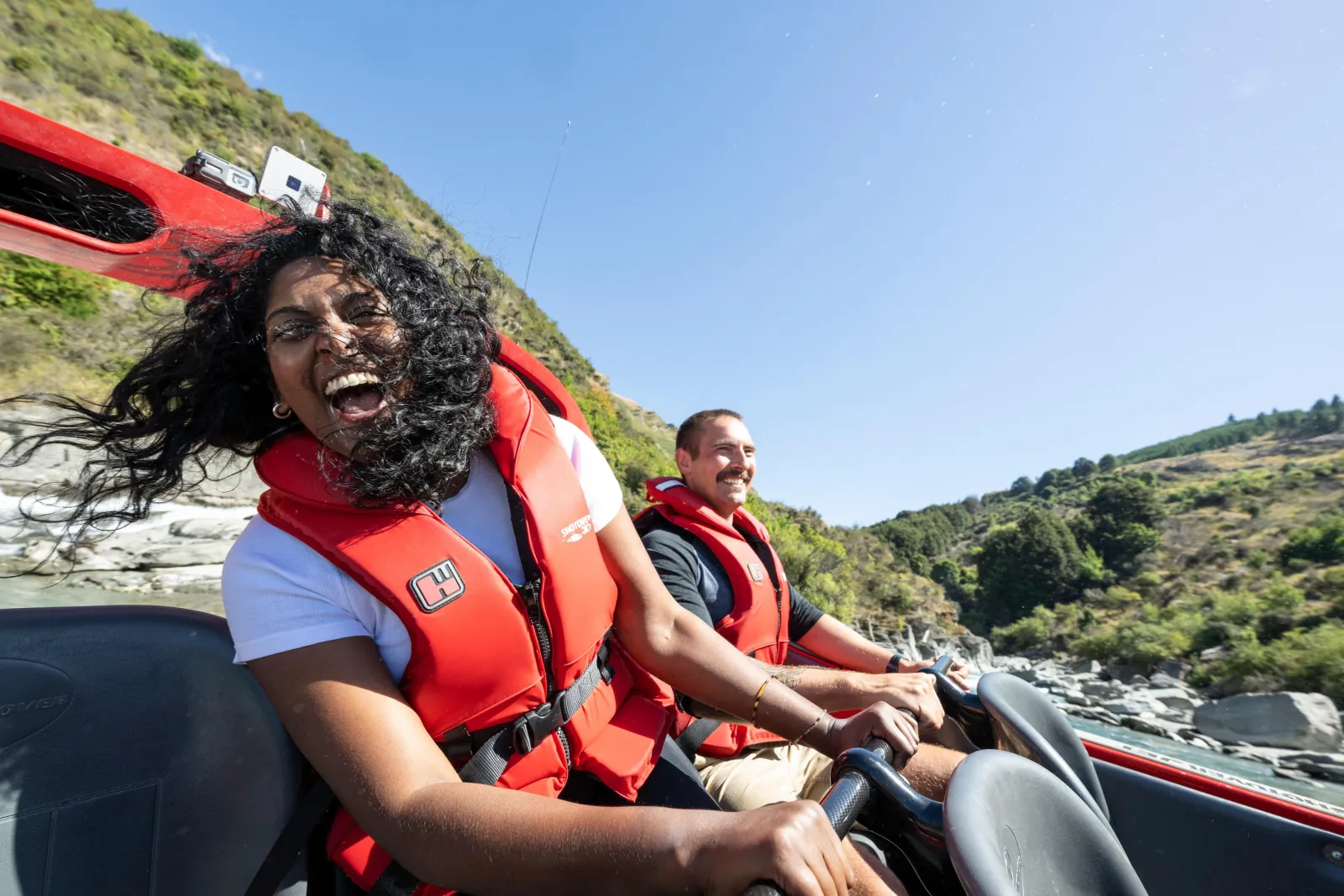
We are independent and not owned by any operator. The record below comes from Transport Accident Investigation Commission (TAIC) reports, Maritime New Zealand, court reporting and the operators’ own safety pages, checked in November 2026.
Jet boat safety at a glance
- Jet boating is safe enough for most travellers, but it isn’t risk-free. New Zealand’s commercial jet boats carry an estimated 370,000 passengers a year, according to the Ministry of Transport’s July 2012 Regulatory Impact Statement (RIS) for Part 82, a Maritime NZ figure confirmed by the NZ Commercial Jet Boat Association. We found two commercial passenger deaths since 1999: Shotover Jet in 1999, and Kawarau Jet on 25 September 2008, when K-Jet 6 hit a sandbar and flipped at the Kawarau–Shotover confluence. Non-fatal crashes still happen, most recently Skippers Canyon Jet (February 2025) and Shotover Jet (10 July 2026, when St John reported five minor injuries and took two people to Lakes District Hospital).
- Strict national rules apply. Every operator must hold a Maritime NZ certificate under Maritime Rules Part 82, every driver needs a Commercial Jet Boat Driver (River) Licence, and every passenger must wear a life jacket. TAIC’s 2026 Skippers Canyon report sums up the recurring lesson: “Canyon jet boating is a high-risk activity that leaves little room for error… Single-engine jet boats are vulnerable to loss of control, because once the engine fails, a jet boat has no steering.” Its investigations also point to driver judgement and to poor passenger protection and briefing.
- What you control: choose a twin-engine operator that is open about risk, listen to the briefing, hold on with both hands, keep your feet braced, and ask what “brace” means before the boat leaves the jetty.
Safety in 30 seconds
- Regulated: Maritime Rules Part 82 (in force since 2 August 2012) covers operators, boats, drivers and briefings. Maritime NZ inspects and audits.
- Rare but real: two passenger deaths on NZ commercial river jet boats since 1999 (1999, 2008), against an estimated 370,000 passengers a year.
- What goes wrong: engine or steering failure (no thrust means no steering), driver error, and hard impacts in narrow canyons.
- Signs of a careful operator: twin engines, long driver training, a clear risk disclosure and brace briefing, and a willingness to cancel in bad conditions.
- If you’re hurt: New Zealand’s ACC scheme covers visitors’ accident injuries on a no-fault basis. You still need travel insurance.
- Shotover Jet verdict: strong safety systems (120 hours of driver training, twin engines, critical-parts tracking) and a real incident history, including the July 2026 rock strike. We’d ride it, and we’d take the family.
To compare the rides themselves, see which Queenstown jet boat to book.
Key findings from the record
- Accidents are rare relative to passenger numbers. The Ministry of Transport’s 2012 RIS counted 94 commercial jet boats, 47 operators and an estimated 370,000 passengers a year. It recorded 48 reported accidents over 2006–2012 and 19 accidents in the previous 10 years that seriously injured or killed passengers.
- Loss of thrust means loss of steering. A jet boat steers by directing its water jet. TAIC puts it plainly: “Single-engine jet boats are vulnerable to loss of control, because once the engine fails, a jet boat has no steering.” Failures behind recent crashes include a fatigued fuse (KJet, 2021), a chafed wiring harness (Skippers, 2025) and under-torqued steering-nozzle bolts (Skippers, 2019).
- Human factors matter as much as hardware. Investigators found driver distraction (Dart River, 2009), misjudgement (Shotover Jet, 2014 and 2015) and, in one prosecuted case, a driver under the influence of drugs and alcohol (Go Orange, Kawarau River, 2020).
- Passenger protection is the open issue in 2026. TAIC’s report on the 2025 Skippers Canyon crash (MO-2025-202, published 16 April 2026) found that “Padding of the seats and surrounds of Discovery 2 did not adequately protect the passengers from injury during a sudden stop.” Passengers hadn’t been told how to brace, and TAIC said “It is likely that some passengers suffered worse injuries due to this uncertainty.” TAIC recommended that Maritime NZ work with industry to improve passenger-protection standards. Maritime NZ said it “will consider this recommendation.”
- The 10 July 2026 Shotover Jet crash has no public cause yet. As of November 2026 we found no published finding and no stated cause; the company said it would not speculate while its review was under way. Treat any website that claims otherwise with caution.
How jet boating is regulated in New Zealand
Commercial river jet boats are regulated by Maritime New Zealand under Maritime Rules Part 82. The rule covers boat design, safety equipment, driver licensing, operating plans and passenger briefings.
Maritime Rules Part 82 (Commercial Jet Boat Operations – River)
- What it covers: commercial jet boats that operate on rivers, carry passengers, are under 9 m long and are designed to carry no more than 34 people (Maritime NZ).
- When: signed into law on 3 July 2012. It replaced the jet boat parts of the older Maritime Rule Part 80, which had regulated river jet boats since 1999.
- Operator certificate: each operation needs a Commercial Jet Boat Operator Certificate, which “must be displayed in a prominent position at the commercial jet boat operation” (Maritime NZ). It sits on top of a Safe Operational Plan (SOP) that sets out the operation’s own river limits, maintenance and procedures.
- Driver licence: every driver must hold a New Zealand Commercial Jet Boat Driver (River) Licence and meet the competency requirements of their operation. The licence came out of a TAIC recommendation after the two 1999 Shotover River accidents. The 2012 RIS described the old system bluntly: “the only test for drivers is that operators are required to ensure drivers have had 50 hours of experience.”
- Inspections and audits: “Maritime NZ regularly inspects jet boats and safety equipment, and audits operations to ensure continued compliance.”
- Passenger rules in the rule text: operators must tell passengers about the risks and give a safety briefing. On thrill-type trips, passengers must be warned before spins. Hard surfaces must be padded where practicable, thrill-trip seating must be forward-facing and adequately upholstered, and operators must review their SOP after every accident, incident or mishap.
- Briefing comprehension: Maritime NZ’s May 2019 safety update reminded operators that “Owners and drivers must not carry a passenger on the trip if they have doubts that the passenger understands the safety briefing.” It also recommends screening and safety information in English, Japanese, Korean, Mandarin and German.
- Drugs and alcohol: Maritime NZ published a safety guideline on managing alcohol and drug risks for jet boat operators in 2020.
Other layers of oversight
- TAIC investigates selected serious accidents to find causes and prevent repeats. It does not assign blame, and its recommendations go to Maritime NZ.
- Health and Safety at Work Act prosecutions: Maritime NZ prosecutes operators and drivers. Fines and reparations have been substantial (see the timeline).
- Rafting is regulated differently. Commercial white-water rafting moved from Maritime Rule Part 81 to WorkSafe’s Health and Safety at Work (Adventure Activities) Regulations 2016 on 1 October 2020. Rafting operators must pass a safety audit and register with WorkSafe. Since 1 April 2024 operators apply directly to WorkSafe, which has stronger powers to suspend or cancel registrations. See our Shotover River rafting guide.
- Qualmark is Tourism New Zealand’s quality mark. Shotover Jet displays it. It’s a useful trust signal, but it doesn’t replace the regulatory certificate.
The safety record: NZ commercial jet boat incident timeline
Since 1999 we found two passenger deaths on NZ commercial river jet boats (1999, 2008) and roughly a dozen notable injury crashes, concentrated on the Shotover, Kawarau and Dart rivers near Queenstown.
The table covers notable commercial incidents with a public investigation or court record. It is not exhaustive: many minor incidents are reported to Maritime NZ but never make the news. Victims are not named.
| Date | Operator / boat | River | What happened | Injuries | Cause and outcome |
|---|---|---|---|---|---|
| 1999 (TAIC 99-212) | Shotover Jet (Shotover 14) | Shotover | Loss of control linked to the steering system | No serious injuries reported | Investigated together with the fatal accident below |
| 12 Nov 1999 (TAIC 99-213) | Shotover Jet (Shotover 15) | Shotover (canyon) | Steering nozzle failed near maximum speed in a narrow gorge; boat struck the canyon wall | 1 passenger killed | Nozzle failure. Hamilton recalled all Mark I nozzles from 212 units; a TAIC recommendation led to driver licensing |
| 16 Jun 2000 (TAIC 00-206) | Huka Jet (Huka Jet 1) | Waikato, Taupō | Engine failure at about 80 km/h; collided with overhanging trees | 2 minor | Engine failure |
| 12 Feb 2001 (TAIC 01-202) | Shotover Jet (Shotover 6) | Shotover | Engine stopped at about 75 km/h with 10 passengers aboard; boat hit the riverbank | 1 passenger moderate, 9 minor; driver minor | TAIC recommended mandatory twin propulsion; the industry review didn’t make it compulsory. Shotover Jet now runs a twin-engine fleet |
| 25 Sep 2008 | Kawarau Jet (K-Jet 6) | Kawarau–Shotover confluence | At about 2.45pm the boat hit a sandbar and flipped, trapping a passenger underneath; 22 passengers plus the driver were aboard (per the KJet director, via ODT/TNT) | 1 passenger killed, 6 injured | Driver charged; found not guilty (2010, NZ Herald) |
| 20 Feb 2009 (TAIC 09-203) | Dart River Jet Safaris (DRJS-11) | Dart, near Glenorchy | Driver pointed out a flock of geese; boat grounded on shingle and rolled | 3 of 18 passengers (2 collarbones, 1 knee) | Driver distraction; TAIC recommendations on distraction, emergency exits and fuel/electrical isolation |
| Dec 2009 | Kawarau Jet | Lake Wakatipu | High-wind incidents and an unreported engine cut-out | None reported | Company admitted two “unnecessary danger” charges and failing to notify |
| 9 Oct 2014 | Shotover Jet | Shotover | Boat struck the canyon wall with nine passengers aboard | None | Maritime NZ found a “lapse of judgement” by the driver |
| 10 Jan 2015 | Shotover Jet | Shotover (gorge) | Driver entered a turn at the wrong angle; boat hit a rock face at about 22 km/h | 12-year-old airlifted (suspected back injury), 4 minor | Driver error (Maritime NZ, March 2015) |
| Feb 2019 (TAIC MO-2019-201) | Skippers Canyon Jet (Discovery 2) | Shotover (Skippers Canyon) | Steering failed; hit the canyon wall at 20–30 km/h | Passenger thrown partly overboard (broken leg); others cut and bruised | Fatigue-cracked nozzle stud-bolts (torque wrench not used). Company fined $50,000 plus $260,000 reparation (2021) |
| 26 Jan 2020 | Go Orange (now part of RealNZ’s brand history) | Kawarau | At about 80 km/h, misjudged a turn and struck two rock faces | 4 injured (including a fractured arm) | Driver had drugs and alcohol in his system. Company fined $150,000, driver $10,000 |
| 21 Mar 2021 (TAIC MO-2021-201) | KJet (KJet 8, single engine) | Shotover | Engine stopped; boat ran into an overhanging branch | Driver and 1 passenger moderate head injuries (airlifted, discharged the same day) | Fuse failed through vibration fatigue. TAIC recommendation 008/22 on single points of failure |
| 2024 (sentenced Oct 2024) | Commercial operator | Clutha | Commercial boat struck a moored recreational jet boat at about 65 km/h | Recreational driver seriously injured | Commercial driver convicted; fine plus about $46,777 reparation |
| 25 Feb 2025 (TAIC MO-2025-202) | Skippers Canyon Jet (Discovery 2, single engine) | Shotover (Skippers Canyon) | Engine cut out at 60–65 km/h; hit the canyon wall at 30–35 km/h | 4 airlifted to Dunedin; fractured wrist, deep laceration needing surgery, cuts and bruising | Chafed wiring harness short circuit. TAIC (April 2026) recommended better passenger-protection standards |
| 10 Jul 2026 | Shotover Jet | Shotover, near Arthurs Point | Boat struck rocks near the company’s base | 5 minor; 2 taken to Lakes District Hospital (14 aboard) | Cause not yet public (as of November 2026) |
Not commercial, often confused: the 5 January 2009 collision between a private jet boat and a personal watercraft on the Kawarau killed two people who weren’t wearing life jackets (TAIC MO-2009-201). Private jet boat accidents on the Dart and other rivers are also not commercial operations. Keep that in mind when you search “jet boat deaths New Zealand.”
What the numbers suggest (our estimate)
These are rough, clearly labelled estimates, not official statistics:
- Serious-or-fatal accidents: the RIS counted 19 in the decade before 2012, against roughly 3.7 million passenger trips (370,000 × 10). That works out to about 1 serious-or-fatal accident per 200,000 trips in that period. This counts accidents, not people, and the decade included the high-incident late 1990s and 2000s.
- Deaths: 2 passenger deaths over roughly 27 years and an estimated 10 million trips (if volumes stayed near 370,000 a year) suggests on the order of 1 death per 5 million trips. Volumes have varied (COVID closed operators in 2020), so treat this as an order of magnitude only.
- Trend: since Part 82 (2012) we found no commercial passenger deaths. Injury crashes continue at roughly one notable event every 1–3 years, mostly hard impacts in canyons.
Why jet boat accidents happen
Almost every serious commercial crash traces back to one of three things: the boat lost thrust or steering, the driver made an error, or the impact injured people who weren’t protected or braced.
1. Mechanical and electrical failure
A jet boat has no rudder. It steers by pointing a high-pressure water jet, so if the engine stops, steering stops too. TAIC found the same pattern in the 2019 Skippers, 2021 KJet and 2025 Skippers crashes: “a single point of failure in a critical jet boat control system, which resulted in total loss of control.” Examples:
- Steering nozzle failure (Shotover 1999; Skippers 2019, where bolts were not torqued to the manufacturer’s specification).
- Engine stoppage (Shotover 2001; Huka 2000).
- Electrical faults (KJet 2021: a fuse cracked from vibration; Skippers 2025: a wiring harness chafed against a casting edge and shorted).
What changed: TAIC recommended mandatory twin engines back in 2001. Regulators didn’t adopt it, but several big thrill operators (Shotover Jet, Thunder Jet, Dart River) now run twin-engine fleets. Maritime NZ issued a safety notice on nozzle stud-bolts. On 27 April 2022 TAIC issued recommendation 008/22 (from the KJet 8 inquiry), asking the Director of Maritime NZ to work with operators to “identify jet boat systems which carry the risk of single point failure that would result in a total loss of control.” How the jet unit steers is explained in what is a jet boat?.
2. Human factors
Driving fast and close to rock walls leaves tiny margins. TAIC called canyon jet boating “a high-risk activity that leaves little room for error.” Recorded human factors include distraction (Dart 2009), misjudged lines (Shotover 2014 and 2015), an impaired driver (Go Orange 2020) and unsafe route choices (Clutha 2024).
What changed: national driver licensing (2012), longer in-house training at the larger operators, and drug and alcohol guidance (2020).
3. Environment and impact
Rivers change daily. Water level, debris and ice all matter, which is why operators set flow limits in their SOPs (Skippers’ limit was 5–60 cumecs; flow on the 2025 crash day was about 25). Most injuries come from sudden stops: people are thrown forward into handrails, seats and each other. In 2025, TAIC found the padding “did not adequately protect the passengers” and that passengers didn’t know how to brace.
What changed: after the 2025 crash, Skippers Canyon Jet improved how it explains risk and safety procedures and fitted a roll bar. TAIC’s 2026 recommendation asks Maritime NZ to raise passenger-protection standards across the industry. Maritime NZ will consult through its harm-prevention work on whether rule changes, practice changes or guidance fit best.
Risk in context: how does jet boating compare?
Jet boating has a higher chance of a frightening, bruising incident than a bus tour, but in New Zealand data its injury burden sits below many everyday and self-guided adventure activities.
Good per-trip injury rates across activities don’t exist for New Zealand, and researchers have complained about this for two decades. The comparisons below come from different methods and years, so read them as direction, not precision.
| Activity / measure | Data point | Source and caveat |
|---|---|---|
| Commercial jet boating, serious-or-fatal accidents | About 1 per 200,000 trips (2002–2012 estimate) | Our estimate from the 2012 Ministry of Transport RIS figures |
| Jet boating, ACC claims by NZ residents | 86 claims in a 12-month period (against 229 for jet skiing) | Bentley, Macky & Edwards, NZ Medical Journal 2006; residents only, includes private boating |
| All adventure tourism and sport, ACC claims | 15,000+ domestic cases in 12 months | Bentley, Page & Macky 2007; mostly slips, trips and falls |
| Commercial adventure operators, client injuries | 0.74 injuries per 1,000 clients (operator-reported) | Bentley et al. operator survey; the authors suspect under-reporting |
| Highest-risk commercial adventure activities | Cycle touring, quad biking, horse riding, white-water rafting | Bentley et al.; activities with falls from a moving vehicle or animal |
| Overseas visitors hospitalised, recreation and adventure | 8.4 per 100,000 visitor arrivals | Bentley et al. 2001, NZ hospital data 1982–1996 |
| Overseas visitors hospitalised, road crashes | About 12 per 100,000 visitors | Same body of research |
Our read: on a Queenstown adventure day, the drive and the self-guided activities (skiing, biking, hiking) probably carry more risk than a guided jet boat. When a jet boat does go wrong, though, the impact is sudden and involves the whole boat, which is why it makes headlines.
How safe is Queenstown adventure tourism overall? It’s a mature, heavily audited industry with a national no-fault injury scheme behind it, which puts it ahead of many destinations. The research consistently finds the highest injury rates in activities where you’re in control (bikes, skis, horses).
Queenstown jet boat operators: safety compared
All the major operators are Maritime NZ-certified. The meaningful differences are twin or single engines, canyon or open-river routes, how openly they disclose risk, and recent incident history.
| Operator | River / type | Engines (as stated) | Notable incidents | Our safety take | Our pick on GetYourGuide |
|---|---|---|---|---|---|
| Shotover Jet (Ngāi Tahu Tourism) | Shotover canyons, very close passes | Twin-engine fleet | 1999 (fatal), 2001, 2014, 2015, July 2026 | Thorough systems (120 hours of training, critical-parts tracking, annual internal and external audits). The most intense canyon run in Queenstown; watch for the July 2026 findings | Shotover River Extreme Jet Boat Experience, from US$113, 4.9 from 1,759 reviews |
| KJet | Lake Wakatipu, Kawarau and lower Shotover | Marketing says twin-engine; the boat in the 2021 TAIC report was single-engine | 2008 (fatal), 2009 (prosecution), 2021 | The world’s first commercial jet boat operator. Ask which boat type you’ll be on | KJet Shotover and Kawarau jet boat ride, from US$84, 4.7 from 2,022 reviews |
| Thunder Jet (Watersports Ltd) | Lake Wakatipu and Kawarau | “Every jet boat in our fleet features twin engines” | None significant found in our search | Publishes a clear risk-disclosure page; Maritime NZ certified and audited | Thunder Jet, from US$56, 4.8 from 256 reviews |
| Skippers Canyon Jet | Upper Shotover, Skippers Canyon | Single-engine (5 boats, per TAIC 2026) | 2019, 2025 | Remote canyon; helicopter evacuation was needed both times. Briefing improved and a roll bar fitted after 2025. We’d want twin engines before ranking it with the best | Skippers Canyon Jet Boat Ride, from US$118, 4.9 from 795 reviews |
| Dart River Adventures (Ngāi Tahu Tourism) | Dart River braided channels, Glenorchy | “Twin engine jet boats” | 2009 rollover | Open braided river: lower canyon-impact risk, longer trip. See Dart River Jet vs Shotover Jet | Dart River Wilderness Jet Boat Experience, from US$181, 4.8 from 171 reviews |
| Hukafalls Jet (Taupō) | Waikato River | Not stated | 2000 engine failure (minor injuries); December 2025 near-miss with a kayaker (no collision) | Long-running and well regarded; outside Queenstown | Sold on Viator, not GetYourGuide: Huka Falls Jet Boat Ride, from NZ$184, 4.8 from 739 reviews |
For ride-by-ride comparisons on thrill, scenery and price, see which Queenstown jet boat to book and Shotover Jet tickets and prices.
Is the Shotover Jet safe? Our verdict
Yes, by industry standards. The Shotover Jet has some of the most rigorous safety systems in jet boating, but it also takes the most aggressive canyon route in Queenstown and has a real incident record, most recently a 10 July 2026 rock strike with five minor injuries.
What Shotover Jet does well, from its own published safety page:
- Driver training: “120 hours of training on the water, 70 hours more than the Maritime NZ commercial license requirement,” plus regular monitoring and driver checks.
- Audits: boats are “audited annually by two independent parties – an internal expert… and an external Maritime New Zealand authorised specialist.”
- Critical-parts tracking: steering nozzles are crack-tested every 500 hours and replaced every 2,000 hours whether or not they’re damaged, a direct lesson from 1999.
- Reliability-Centred Maintenance (an airline-industry method) since October 2001, daily mechanical checks, an annual refit programme and daily morning river checks.
- Twin-engine fleet.
- Plain disclosure: its safety page says “While extremely rare, there is a possibility of serious accidents.”
The record: one fatal accident (1999) and several injury crashes since: 2001 (engine failure), 2015 (driver error, child airlifted), 2026 (cause not yet public). Over more than 50 years the company says it has carried more than 3.7 million customers (Ngāi Tahu, 2020).
About the July 2026 crash: RNZ, ODT, NZ Herald and 1News report that a boat with 14 aboard struck rocks near Arthurs Point at about 3.15pm on 10 July 2026. St John assessed five people with minor injuries and took two to Lakes District Hospital. Ngāi Tahu Tourism said it was “working closely with the relevant authorities.” As of November 2026 we found no published cause and no TAIC report. Some sites (queenstowntourism.com, newswire.co.nz) published details that conflict with mainstream reporting, including a morning crash time, six injured, all five hospitalised and a TAIC-led suspension. We don’t rely on them.
Verdict: we’d ride the Shotover Jet and bring older kids. The realistic risk is bruising or a scare, not a catastrophe. If you have back or neck problems or are pregnant, skip it (see who can ride the Shotover Jet). Our full review is is the Shotover Jet worth it?
How to choose a safe jet boat operator: checklist
Look for the Maritime NZ operator certificate, twin engines, long driver training, a clear risk briefing that explains bracing, and an operator that cancels when the river is wrong.
| Check | Why it matters | How to verify |
|---|---|---|
| Maritime NZ Commercial Jet Boat Operator Certificate | Legal requirement under Part 82; proves an audited SOP | It must be displayed prominently at the base. Ask to see it |
| Licensed drivers and training hours | The licence is mandatory; training beyond the minimum is a strong signal | Ask: “How many training hours before a driver takes passengers?” (Shotover Jet: 120) |
| Twin engines | One engine failing doesn’t mean losing all thrust and steering | Ask: “Are all boats twin-engine?” |
| Risk disclosure | TAIC found uninformed passengers braced badly and were hurt worse | Read the operator’s risk page before booking |
| Brace instructions | No national standard brace position exists yet | Ask: “What do I do if you shout ‘brace’?” |
| Padding, handrails, roll bar | Sudden stops throw people forward | Look at the boat; front-row rails should be padded |
| Screening questions | Part 82 requires passenger screening (health, understanding) | A good operator asks about back or neck issues, pregnancy and language |
| Weather and river cancellations | SOPs set flow and weather limits | A company that cancels is following its plan, so don’t push |
| Track record and transparency | How they handle incidents says a lot | Check TAIC and Maritime NZ reports and the news; see our timeline |
| Qualmark | Quality and sustainability mark (not a safety licence) | Logo on the website; Qualmark directory |
| Staff behaviour | Professional, sober, unhurried crew | Trust your gut; Maritime NZ prosecuted an impaired driver in 2020 |
Questions to ask at check-in:
- Is this boat twin-engine?
- How long has today’s driver been driving this river?
- What’s the brace position, and when will you call it?
- Where should I sit if I have a sore back or neck?
- What happens if the boat stops in the canyon? How do you get us out?
How to ride safely: passenger tips
Stay seated, keep both hands on the rail, plant your feet, secure loose items, and tell the crew about any medical issues before you board.
- Listen to the whole briefing. If you don’t understand it, say so. Under Maritime NZ’s guidance, drivers shouldn’t take you if they doubt you understood.
- Hold on with both hands, always, and especially before spins. The Skippers driver in 2025 told passengers to hold “with both hands and bracing with their feet” before spins. Keep that grip for the whole ride.
- Brace with your feet. Plant both feet flat and firm against the floor or footwell so your legs, not your face, take a sudden stop.
- The “brace” call: there’s no national standard yet (TAIC 2026), so ask your driver. Common-sense principles are a firm two-handed grip, feet planted, back against the seat, and head down and back instead of forward toward the rail. Follow the operator’s instruction if it differs.
- Seat choice: in the 2025 Skippers crash, front-row passengers suffered some of the worst injuries (a deep knee laceration needing surgery, facial injuries). If you have neck or back concerns, ask the crew where to sit.
- Kids: sit them between adults and make sure their life jacket is snug. See who can ride the Shotover Jet for height minimums (the Shotover Jet’s is 1 m, raised in some conditions).
- Loose items: use the lockers. Glasses need a strap. Many operators restrict handheld cameras and phones.
- Medical disclosure: tell the crew about back or neck injuries, recent surgery, heart conditions or pregnancy before boarding.
- Clothing: dress for spray and cold, since Queenstown winters are icy. Gloves help your grip. Our winter jet boating guide has the full cold-weather list.
- When to say no: if you’re intoxicated, can’t hold on with both hands, the briefing was rushed or unintelligible, or the crew seem careless. You can also step off if the river looks wild and they’re still going.
Jet boat life jackets (and rafting life jackets) explained
On commercial jet boats, life jackets are mandatory, supplied by the operator, fitted before you board, and worn the whole time you’re on the river. You don’t need to bring your own.
What Part 82 requires
- “Every passenger must be correctly fitted with a personal flotation device… before they board” and “Every person on board a commercial jet boat must wear his or her personal flotation device when the boat is on the river” (Part 82, Appendix 1).
- Operators must supply type 401, 402 or 406 PFDs under NZS 5823:2005, the New Zealand lifejacket and buoyancy-aid standard. Maritime NZ can accept equivalent internationally certified PFDs.
- Not covered by the new recreational law: the Lifejackets on Recreational Craft rule (in force from 9 October 2026) requires everyone on recreational craft 6 m and under to wear a life jacket while underway. It does not apply to commercial vessels, which have their own rules, but it applies if you hire a private boat or kayak.
Fitting tips
- Do up every buckle and zip, then pull the shoulders up hard. The jacket shouldn’t ride past your chin or ears.
- Kids need kid-sized jackets. If it slips over their head, ask for a smaller size.
- Don’t loosen it mid-ride to get comfortable.
White-water rafting life jackets
Commercial rafting operators (registered with WorkSafe under the Adventure Activities Regulations) supply white-water PFDs, helmets and usually wetsuits, for example on the Shotover River Whitewater Rafting Adventure (from US$169, 4.8 from 343 reviews). Rafting jackets are designed for swimming in moving water and are usually higher-buoyancy and closer-fitting than lake jackets. Again, you don’t need to buy one. More in our rafting guide.
If you’re shopping for “safety life jackets” or “professional life jackets”
For your own boat or kayak in New Zealand, buy a jacket certified to NZS 5823 or an accepted international equivalent, sized by weight, with a crotch strap for kids. Choose a bright colour and add a whistle. Auto-inflating jackets suit adults on larger boats but aren’t designed for white water or for children.
What happens if there’s an accident?
Drivers radio base, staff and emergency services (St John, Fire and Emergency, rescue helicopters) respond, and Maritime NZ, sometimes with TAIC, investigates. ACC covers your accident-related treatment in New Zealand even as a visitor.
On the river
In recent incidents, other company boats arrived within minutes to transfer passengers. Helicopters evacuated injured people from roadless canyons (Skippers 2019 and 2025, KJet 2021). TAIC’s timeline for the 2025 Skippers crash shows impact at about 1702 and the first of two helicopters arriving at Sarges Pool at about 1810, roughly an hour later. The last evacuee left at 1918, bound for Dunedin hospital. Remote canyon trips are further from help.
ACC: New Zealand’s no-fault injury cover
- ACC “covers everyone, including visitors, who are injured in an accident in New Zealand.” “You’ll receive the same ACC cover as everyone else… It doesn’t matter if you’re not a resident.”
- It helps pay for treatment in New Zealand. You may pay part of some appointment fees. Claims are made through a medical professional within 12 months.
- ACC doesn’t cover: illness, disrupted travel plans or emergency travel home, injuries in transit to or from New Zealand, or treatment and rehabilitation once you’re back home.
- The trade-off: because ACC is no-fault, you generally can’t sue an operator for personal-injury compensation in New Zealand, although Maritime NZ prosecutions can still produce court-ordered reparation for victims (for example $260,000 in the 2019 Skippers case).
Travel insurance
You still need it for flights home, a companion’s costs, cancelled trips, illness and care after you leave New Zealand. Check that your policy doesn’t exclude “adventure activities” or “jet boating.” Many mainstream policies include commercial jet boating, but check before you book.
How to report a concern
If you see unsafe practice (a drunk driver, no briefing, missing life jackets), report it to Maritime NZ. Note the date, time, boat name or number, and take photos if it’s safe to.
Frequently asked questions
Is jet boating safe?
Commercial jet boating in New Zealand is regulated, audited and statistically low-risk. We found two passenger deaths on commercial river jet boats since 1999 against an estimated 370,000 passengers a year. Crashes causing injuries still happen every few years.
Is the Shotover Jet safe?
Yes, by industry standards. It has twin-engine boats, 120 hours of driver training and critical-parts tracking. It has also had incidents, including a fatal accident in 1999 and a 10 July 2026 rock strike with five minor injuries.
Has anyone died on the Shotover Jet?
Yes. One passenger died in November 1999 when a steering nozzle failed in the canyon. The investigation led to a nozzle recall and national driver licensing.
What happened in the Shotover Jet crash in July 2026?
On 10 July 2026 a boat carrying 14 people struck rocks near Arthurs Point. Five had minor injuries and two went to Lakes District Hospital. As of November 2026 no cause has been published.
Was there a KJet accident?
Yes. In 2008 a Kawarau Jet boat flipped at the Kawarau–Shotover confluence, killing one passenger (the driver was acquitted). In 2021 KJet 8 lost power and hit an overhanging branch, injuring the driver and a passenger.
What happened in the Skippers Canyon jet crash?
In February 2025 an electrical short circuit stopped the engine of Discovery 2, which hit the canyon wall at 30–35 km/h. Four people were airlifted. A 2019 crash on the same boat was caused by failed steering bolts and led to a $50,000 fine plus $260,000 reparation.
How many people have died jet boating in New Zealand?
On commercial river jet boats, we found two passenger deaths since 1999 (1999 and 2008). Other deaths have occurred in private and recreational jet boating and in jet boat racing, which are separate from tourist rides.
Are jet boats dangerous?
They carry inherent risk: TAIC calls canyon jet boating “a high-risk activity that leaves little room for error.” Regulation, driver training and maintenance keep serious outcomes rare.
What is Maritime Rules Part 82?
New Zealand’s rule for commercial river jet boats, in force since 2 August 2012. It requires operator certificates, safe operational plans, licensed drivers, safety briefings and mandatory life jackets.
Do you have to wear a life jacket on a jet boat?
Yes. Under Part 82 every passenger must be fitted with an approved PFD before boarding and wear it on the river. The operator supplies it.
What is the brace position on a jet boat?
There’s no national standard yet (TAIC flagged this in 2026), so ask your driver. Generally: both hands gripping the rail, feet planted, back against the seat, head not thrust forward.
What are the most common jet boat injuries?
Bruising, cuts, neck and back strains, and occasional fractures (wrist, collarbone, leg) from sudden stops or rollovers.
Does ACC cover tourists injured jet boating?
Yes. ACC covers visitors’ accident injuries in New Zealand. It doesn’t cover travel disruption, flights home or treatment after you leave, so buy travel insurance.
Is jet boating safe for kids?
Generally yes, within height and age limits. The Shotover Jet’s minimum is 1 m tall. See who can ride the Shotover Jet.
Is jet boating safe when pregnant?
Operators advise against it, and the Shotover Jet does not allow it at any stage. Thunder Jet states it’s “not suitable for pregnant women.”
How safe is Queenstown adventure tourism?
It’s a mature, heavily audited industry. New Zealand research finds the highest injury rates in activities like cycling, quad biking, horse riding and rafting, not in guided jet boating.
Related reading
- Is the Shotover Jet worth it?
- Shotover River guide
- Skippers Canyon jet boat guide
- Queenstown jet boat combos
- Jet boating in Queenstown in winter
Jet boating in Queenstown is a regulated thrill with a long safety record that is mostly good and not perfect. Choose a twin-engine operator that’s open about risk, take the briefing seriously, hold on and brace, and you’ve done nearly everything a passenger can. We’d book the Shotover Jet again; check your date first, because river conditions can change the schedule.
Ride the Shotover Canyons
Twenty-five minutes on the water, 360-degree spins between the canyon walls, and a ten-minute drive from Queenstown. Free cancellation up to 24 hours before you go.
Check Availability & Book